Creating a RAG Chatbot for Film Suggestions Utilizing Qdrant and OpenAI
Creates a movie recommendation chatbot utilizing a RAG approach, employing Qdrant for information retrieval and OpenAI for content generation.
How it works
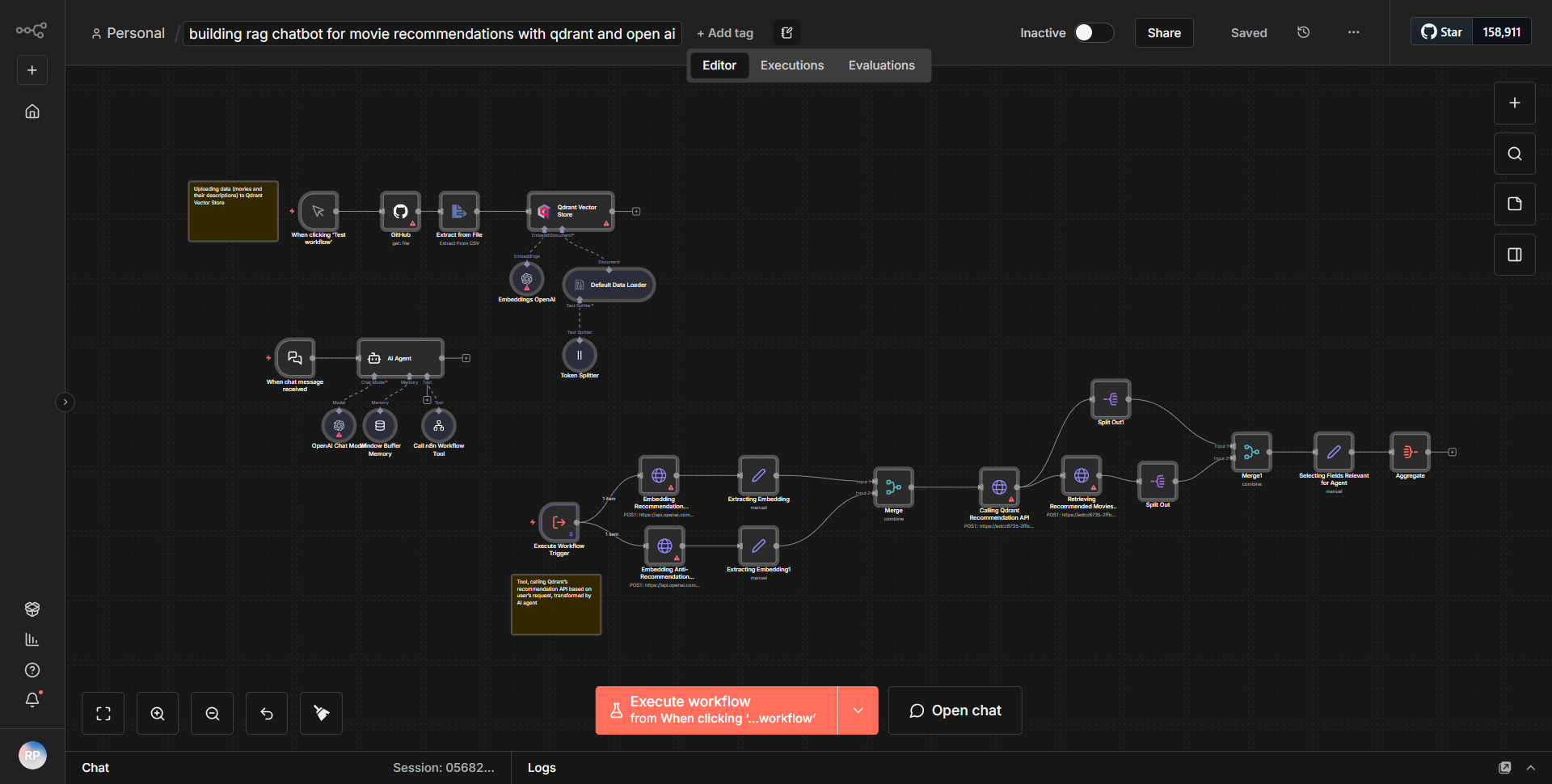
The workflow for creating a movie recommendation chatbot using a Retrieval-Augmented Generation (RAG) approach involves several interconnected nodes that facilitate data retrieval and content generation. The process begins with a trigger node that listens for incoming user queries. Once a query is received, it is passed to the Qdrant node, which is responsible for retrieving relevant movie data from a pre-indexed dataset. This dataset contains various movie attributes, such as titles, genres, and descriptions.
After the Qdrant node retrieves the relevant information, the data is formatted and sent to an OpenAI node. This node utilizes the OpenAI API to generate a conversational response based on the retrieved movie data. The response is crafted to provide personalized movie suggestions to the user. Finally, the generated response is sent back to the user through a designated output node, completing the workflow.
The connections between the nodes are crucial for the flow of data. The trigger node initiates the process, leading to the Qdrant node for data retrieval, which then feeds into the OpenAI node for content generation, and concludes with the output node delivering the final response to the user.
Key Features
This workflow boasts several key features that enhance its functionality and user experience:
1. RAG Approach:
By combining information retrieval with generative AI, the workflow provides more accurate and contextually relevant movie recommendations.
2. Dynamic User Interaction:
The chatbot can engage in real-time conversations, adapting its responses based on user queries and preferences.
3. Integration with Qdrant:
The use of Qdrant for information retrieval ensures that the chatbot can access a vast database of movie information efficiently, improving response times and relevance.
4. OpenAI Content Generation:
Leveraging OpenAI's capabilities allows for natural language responses that are coherent and engaging, enhancing the overall user experience.
5. Scalability:
The architecture of the workflow allows for easy scaling, enabling the addition of more data sources or enhancements to the recommendation logic.
Tools Integration
The workflow integrates several tools and services to function effectively:
1. Qdrant:
Utilized for information retrieval, this node queries the movie database to fetch relevant movie data based on user input.
2. OpenAI:
This node generates conversational responses using the OpenAI API, crafting personalized movie suggestions based on the retrieved data.
3. n8n Trigger Node:
Initiates the workflow upon receiving user queries, serving as the entry point for the entire process.
4. Output Node:
Sends the final generated response back to the user, completing the interaction cycle.
API Keys Required
To ensure the workflow operates correctly, the following API keys and credentials are required:
1. OpenAI API Key:
Necessary for authenticating requests to the OpenAI API for generating responses.
2. Qdrant API Key:
Required for accessing the Qdrant service to perform data retrieval operations.
If there are no additional API keys or configurations needed, it should be noted that the workflow relies solely on these two keys for its functionality.