Leveraging External Workflows as Instruments in n8n
Shows how to utilize external workflows as resources in n8n.
How it works
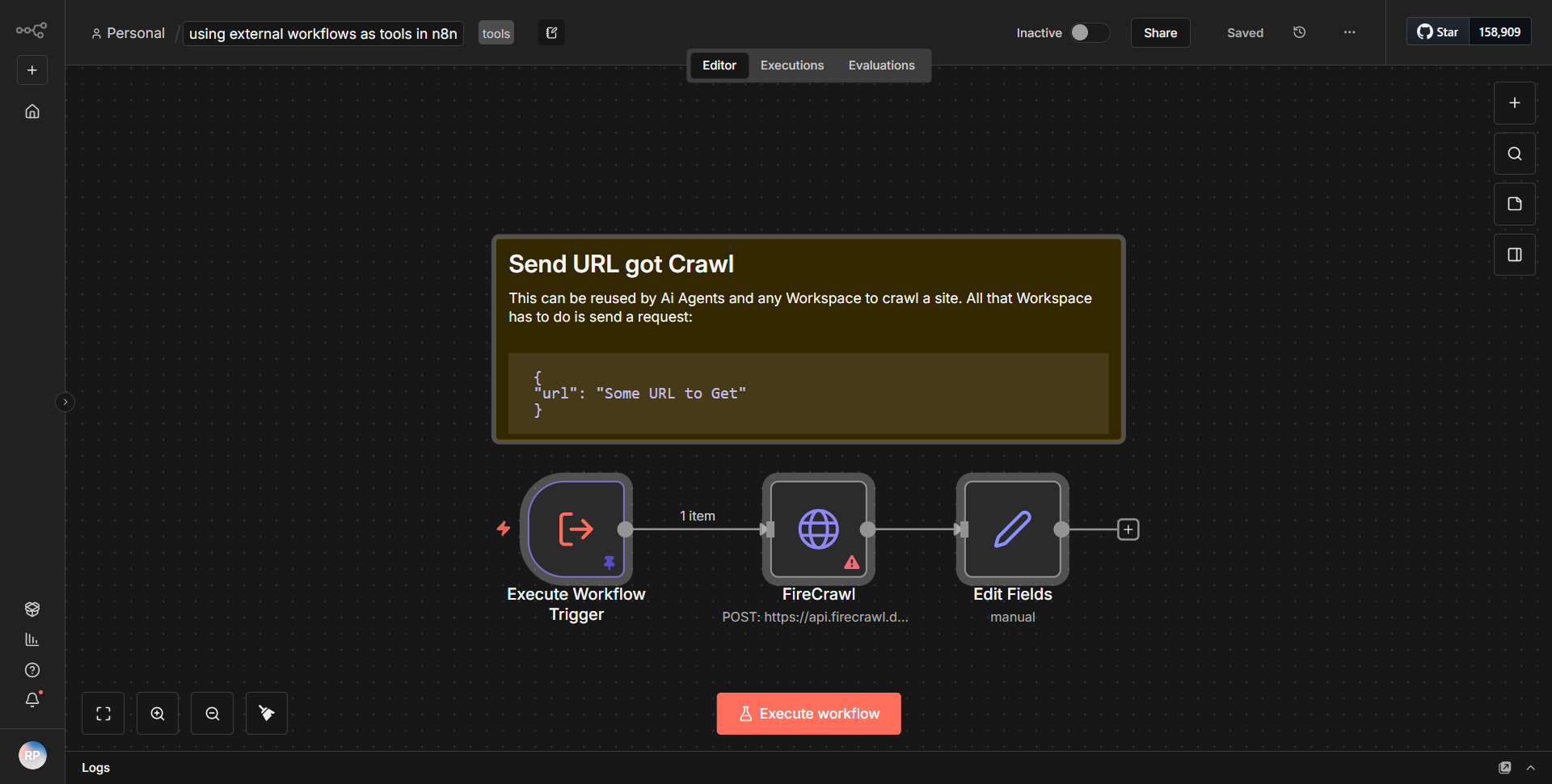
The workflow titled "Leveraging External Workflows as Instruments in n8n" demonstrates how to utilize external workflows as resources within the n8n automation platform. The workflow begins with a trigger node that initiates the process, typically set to respond to an event or a scheduled time. Once triggered, the workflow proceeds to execute a series of nodes that perform specific tasks.
1. Trigger Node:
The workflow starts with a trigger node that listens for incoming events. This could be a webhook, a scheduled trigger, or any other event-based trigger supported by n8n.
2. HTTP Request Node:
Following the trigger, the workflow utilizes an HTTP Request node to call an external workflow. This node is configured with the necessary URL and method (GET, POST, etc.) to interact with the external resource. The response from this request is captured for further processing.
3. Function Node:
After receiving the response from the external workflow, a Function node processes the data. This node can manipulate the data as needed, such as extracting specific fields or transforming the data format.
4. Set Node:
The workflow may include a Set node to define or modify the output data structure. This node allows the user to specify which data points should be passed to the next steps in the workflow.
5. Final Output:
The final node in the workflow could be another HTTP Request node or a different type of node that sends the processed data to a specified endpoint or service, completing the workflow.
Throughout this sequence, the data flows from the trigger to the HTTP Request node, then to the Function node, and finally to the Set node before reaching the output destination. Each node is connected in a linear fashion, ensuring a smooth transition of data and operations.
Key Features
1. External Workflow Integration:
This workflow uniquely demonstrates how to leverage external workflows, allowing users to extend their automation capabilities by integrating with other systems or processes.
2. Data Transformation:
The inclusion of a Function node allows for custom data manipulation, enabling users to tailor the output to meet specific requirements.
3. Flexible Trigger Options:
The workflow can be initiated by various types of triggers, making it adaptable to different use cases and environments.
4. Modular Design:
By utilizing nodes such as Set and Function, the workflow promotes a modular approach, allowing for easy updates and maintenance.
5. Error Handling:
The workflow can be designed to include error handling mechanisms, ensuring that failures in external workflows do not disrupt the entire process.
Tools Integration
The workflow integrates with several tools and services through the following n8n nodes:
1. HTTP Request Node:
Used to make requests to external workflows or APIs.
2. Function Node:
Allows for custom JavaScript code execution to manipulate data.
3. Set Node:
Used to define or modify the output data structure.
These nodes facilitate seamless communication and data handling between n8n and external systems.
API Keys Required
For this workflow to function correctly, the following API keys or authentication credentials may be required:
1. API Key for External Workflow:
If the external workflow requires authentication, an API key or token must be provided within the HTTP Request node settings.
If no external authentication is needed, then no API keys are required. It is essential to review the specific configuration of the HTTP Request node to determine the exact requirements.