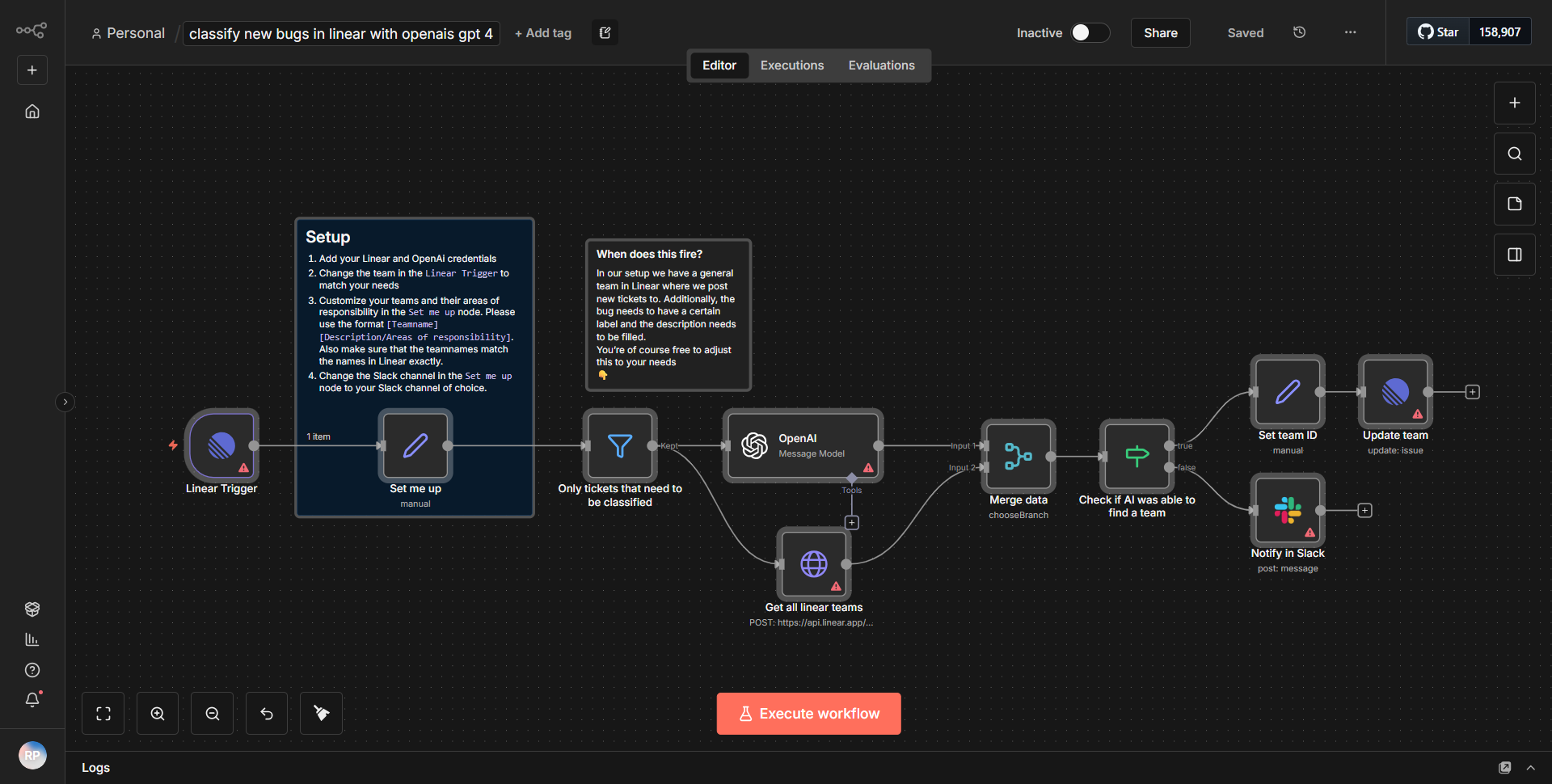
Categorize newly reported bugs in Linear using OpenAI's GPT-4.
Utilizes AI to automatically categorize and direct new bug reports in Linear.
How it works
The workflow titled "Categorize newly reported bugs in Linear using OpenAI's GPT-4" is designed to automate the categorization of bug reports submitted in Linear, leveraging the capabilities of OpenAI's GPT-4 model. The workflow operates in a sequential manner, utilizing various nodes to process incoming data and generate the desired outputs.
1. Trigger Node:
The workflow begins with a trigger node that listens for new bug reports in Linear. This node is configured to activate whenever a new issue is created, capturing the relevant details of the bug report.
2. Set Node:
Following the trigger, a Set node is employed to format the data received from the Linear trigger. This node extracts necessary information such as the bug report title and description, preparing it for the next step.
3. OpenAI GPT-4 Node:
The formatted data is then sent to the OpenAI GPT-4 node. Here, the workflow utilizes the AI model to analyze the content of the bug report. The node is configured to prompt GPT-4 with the bug report details, asking it to categorize the issue based on its content. The output from this node will include the suggested category for the bug.
4. Linear Node:
After receiving the category from GPT-4, the workflow proceeds to a Linear node. This node updates the original bug report in Linear with the category provided by the AI. It ensures that the categorization is reflected in the bug tracking system, allowing for better organization and prioritization of issues.
5. End Node:
Finally, the workflow concludes with an End node, marking the completion of the process. This node signifies that the bug report has been successfully categorized and updated in Linear.
Throughout this workflow, data flows seamlessly from one node to another, ensuring that each step builds upon the previous one, resulting in an efficient categorization process.
Key Features
- Automated Categorization:
The primary feature of this workflow is its ability to automatically categorize bug reports using AI, reducing manual effort and improving efficiency.
- Integration with Linear:
The workflow is directly integrated with Linear, allowing for real-time updates to bug reports as they are categorized.
- Utilization of GPT-4:
By leveraging OpenAI's GPT-4, the workflow benefits from advanced natural language processing capabilities, enabling it to understand and categorize complex bug descriptions accurately.
- Customizable Prompts:
The workflow allows for customization of the prompts sent to GPT-4, enabling users to adjust the categorization criteria as needed.
- Real-time Processing:
The immediate response to new bug reports ensures that categorization happens in real-time, facilitating quicker resolutions and better project management.
Tools Integration
- Linear:
The workflow integrates with Linear through its API, utilizing nodes specifically designed for interacting with Linear's issue tracking system.
- OpenAI GPT-4:
The workflow employs the OpenAI GPT-4 node to process and analyze the text of bug reports, leveraging AI for categorization.
- n8n Nodes:
The workflow utilizes various n8n nodes including the Trigger node for initiating the workflow, the Set node for data formatting, and the Linear node for updating issues.
API Keys Required
- OpenAI API Key:
An API key for OpenAI is required to access the GPT-4 model for processing bug reports.
- Linear API Key:
An API key for Linear is necessary to authenticate and authorize the workflow to create and update issues in the Linear system.
No additional API keys or credentials are mentioned as required for the functioning of this workflow.